


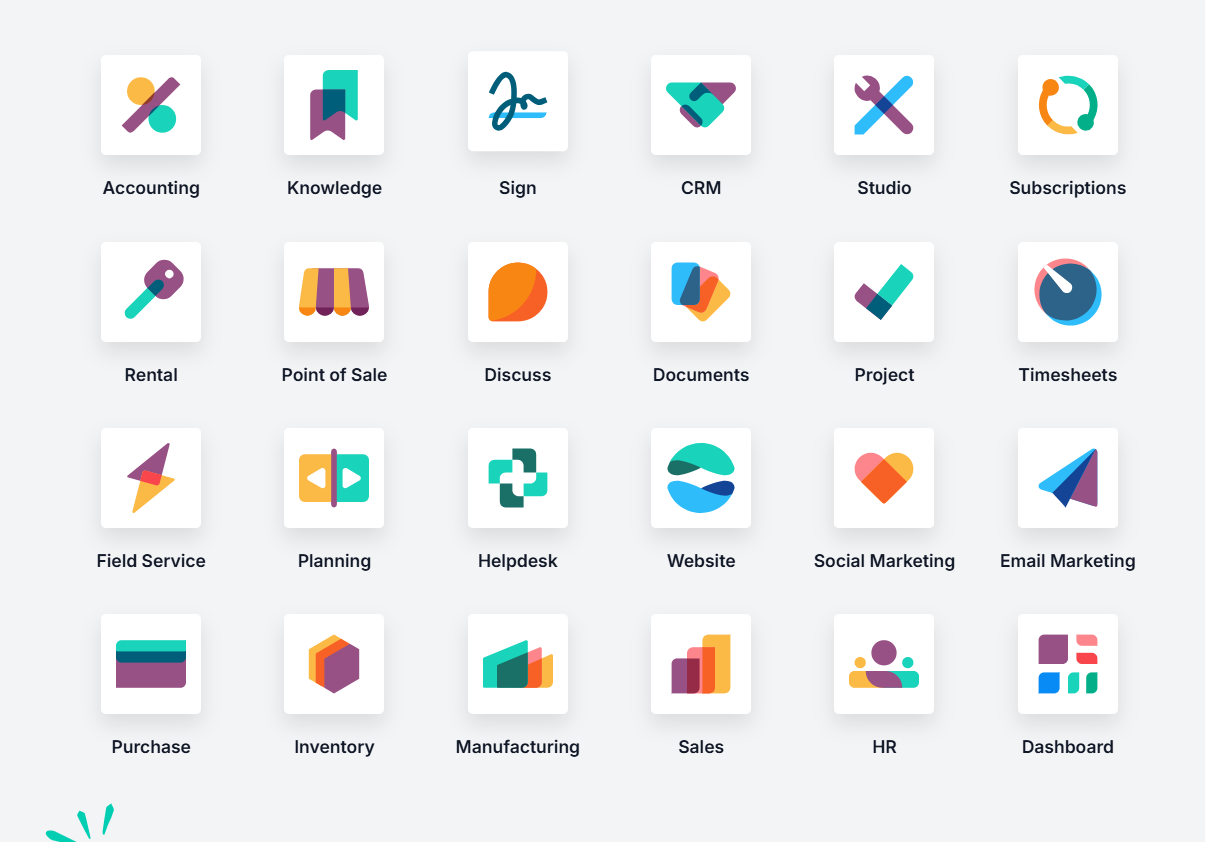
In today’s fast-moving business world, companies need a flexible system that helps manage sales, inventory, HR, accounts, and the website — all in one place. This is where Odoo becomes a game-changer. Odoo is one of the most powerful, modern, and open-source ERP systems in the world. Whether you run a small startup or a large enterprise, Odoo provides everything you need to digitalize and automate your business processes. This beginner-friendly guide will help you understand what Odoo is, how it works, its main features, and why thousands of companies are shifting to Odoo every year.
What is Odoo?
Odoo is an all-in-one, open-source ERP and business management platform that offers more than 80+ integrated business apps, including:
- Sales
- CRM
- Accounting
- Inventory
- Manufacturing
- HR & Payroll
- Website & eCommerce
- Purchase
- Projects
- Marketing
- POS
- Helpdesk
- And many more
It is designed to replace multiple software and bring everything into a single system. Odoo is used by 12+ million users globally, making it one of the most popular ERP systems in the world.
Why Odoo is So Popular?
Companies choose Odoo because it is:
Open-source & cost-effective
Odoo Community Edition is completely free. You can customize it however you want.
Fully integrated
All apps talk to each other — no need to integrate different software.
Highly customizable
You can modify workflows, fields, screens, reports, and logic easily.
User-friendly interface
Modern design, fast navigation, and mobile-friendly UI.
Scalable
Start with a few modules and expand as your business grows.
Large global community
Thousands of developers, contributors, and ready-made apps.
Odoo Community vs Enterprise — What’s the Difference?
Odoo comes in two editions:
Odoo Community (Free & Open-source)
- 100% free
- No license fee
- Perfect for small businesses
- Highly customizable
- Does not include some advanced features (e.g., accounting enterprise features, studio, helpdesk, advanced inventory)
Odoo Enterprise (Paid)
- Includes extra advanced apps
- Premium support
- Mobile app
- Better performance
- Suitable for medium & large companies
Which one to choose?
If you’re a startup or developer → Community
If you need advanced features → Enterprise
How Does Odoo Work? (Simple Explanation)
Odoo works through modules.
Each module focuses on one business area, and all modules are connected.
For example:
- Sales → confirms sale order
- Inventory → auto reduces stock
- Accounting → creates invoices
- Purchase → triggers reordering rules
This automatic flow saves time, reduces errors, and creates real-time visibility across departments.
Backend (ERP)
Employees run operations like inventory, accounting, and manufacturing.
Frontend (Website)
Customers interact through the website, eCommerce, portal, payment, support tickets. Together, Odoo becomes a complete end-to-end business solution.
Major Odoo Modules Explained (For Beginners)
Here is a quick overview of the most used modules:
CRM (Customer Relationship Management)
Manage leads, opportunities, and customer communication.
Sales
Create quotations, confirm orders, manage pricelists and customers.
Inventory
Barcode management, stock tracking, warehouse operations, reordering rules.
Accounting
Invoices, bills, payments, bank reconciliation, reports, taxes.
Purchase
Purchase orders, vendor management, procurement automation.
Manufacturing
(MRP) BoM (Bill of Materials), work orders, production planning, QC.
HR & Payroll
Employee management, attendance, leaves, salaries.
Projects & Tasks
Plan projects, assign tasks, track deadlines.
Website & eCommerce
Build websites, online store, blogs, product pages.
POS (Point of Sale)
Retail store billing, barcode scanning, POS sessions. Each module can be installed from the Apps menu with one click.
Who Should Use Odoo?
Odoo is suitable for almost every industry:
- Manufacturing
- Retail
- Trading
- Construction
- Service companies
- Healthcare
- Education
- E-commerce
- Restaurants
- Automotive
- Logistics
From small shops to large enterprises, Odoo can support all business sizes.
Advantages of Using Odoo ERP
One system for the entire business
No need to use Excel, Tally, QuickBooks, and multiple softwares.
Automation of daily tasks
Odoo saves hundreds of working hours.
Real-time reporting
Live dashboards and KPIs.
Cloud + On-premise
Use Odoo on cloud servers or your own local machine.
Customization & integration
Easily integrate with payment gateways, SMS, WhatsApp, etc.
Odoo for Developers — Why It’s Amazing
Odoo is powerful for developers because:
- Python-based backend
- PostgreSQL database
- XML views
- OWL JavaScript framework
- API friendly
- Easy module structure
- Huge community support
You can extend or modify any functionality. If you want to become an Odoo developer, learning Odoo is one of the best career choices in 2025.
Is Odoo Good for Beginners?
Yes! Odoo is one of the easiest ERPs for beginners.
You can start with simple modules like CRM, Sales, and Inventory. As you learn, move to Accounting and Manufacturing.
Because of its simplicity, Odoo is used by students, developers, business owners, freelancers, and even large IT companies.
Final Thoughts — Why You Should Learn Odoo in 2025
Whether you want to grow your business or build your career, Odoo offers unlimited opportunities.
- Growing ERP market
- Huge job demand
- Perfect for freelancers
- Best open-source business platform
- Easy to learn
- Scalable and future-proof
If you want to start your journey with ERP systems, Odoo is the best place to begin.

2 Comments
Best article about what Odoo is ? ver very informative for learning odoo erp.
Very helpful